





Company registration is provided by the programme partner — eRes Consultancy Ltd. The eResidency state programme provides digital identification and access to services; the registration itself is carried out by the partner under its own licence.
The registration service fee is not included in the annual eResidency price and is paid separately at the partner's rates. The service agreement is concluded directly with the partner.
e-Residents open accounts remotely, keep money in them, pay by card and exchange currency — all inside Kazakhstani banks.
transferred into Kazakhstan by non-residents over a year through a single bank
held by e-residents in accounts at one partner bank right now
spent by e-residents on cards of one partner bank since the start of 2026
Partner bank data as of 23.09.2026 · statistics of incoming cross-border transfers over a year.
Converted at the National Bank of Kazakhstan rate of ₸441.68 per US dollar as of 25.09.2026.
eResidency is a digital identifier for remote access to financial and business services in Kazakhstan: opening a bank account with a Kazakhstani bank, registering a company in the AIFC, investment services, and an eSIM with a Kazakhstani number.
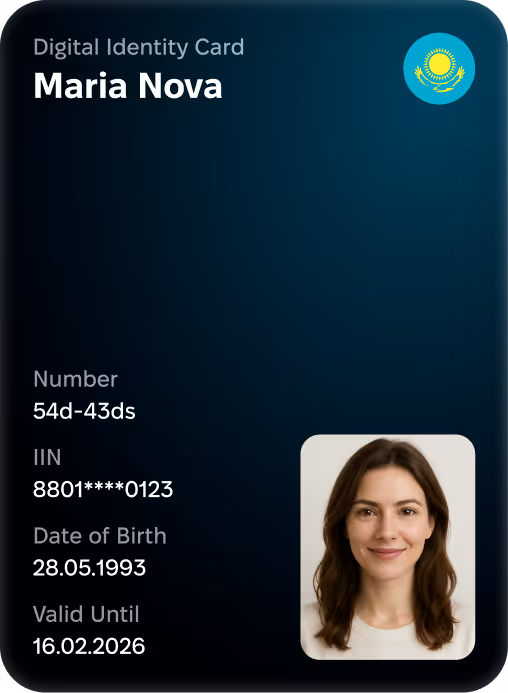
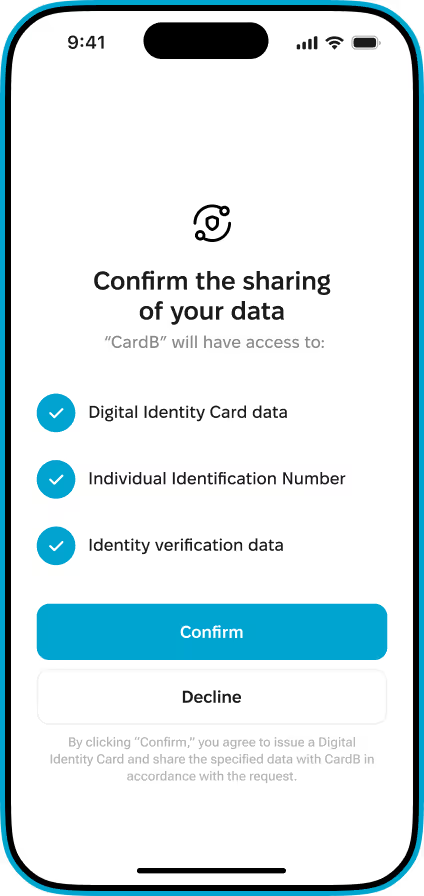
After online verification you receive a Digital Identity Card and an IIN for use in digital environments. eResidency is not a visa, residence permit, or citizenship — there is no need to travel to Kazakhstan.
A foreign national or stateless person aged 18 or older may apply, provided they:
Russian Federation citizens not under sanctions may apply, subject to Enhanced Due Diligence (EDD).
The final decision is made by the programme operator based on KYC/AML and sanctions screening. The registration fee is non-refundable if the application is denied.
After submitting your application, you will receive a Digital Identity Card and IIN, a Kazakhstan eSIM, the ability to open a bank account, and access to digital and business services.
The following cannot apply:
A full list of restricted jurisdictions will be published on the Compliance & Sanctions page.
The programme operator is Verum Payments Limited, a private company registered in the Astana International Financial Centre (AIFC).
The programme is implemented as part of a state programme of the Government of the Republic of Kazakhstan. IINs are issued by the Ministry of Internal Affairs of Kazakhstan.
Upon application, real-time screening is conducted against:
Lists are updated within 24 hours of official updates by sanctions authorities. Active e-residents are additionally re-screened daily.
If an active e-resident is added to a sanctions list, the programme:
No. Obtaining e-residency status, an IIN and a Digital Identity Card does not automatically create tax residency in the Republic of Kazakhstan and does not exempt you from tax obligations in your country of actual residence.
Kazakhstan tax residency is determined by the Tax Code based on actual presence criteria.
Important: Kazakhstan participates in the OECD Common Reporting Standard (CRS). Information about your transactions in Kazakhstani banks is automatically shared with the tax authorities of your country of tax residency.
The Republic of Kazakhstan participates in the Multilateral Competent Authority Agreement (MCAA) and automatically shares financial-account information of non-residents under the OECD Common Reporting Standard (CRS).
Data shared includes:
Data is transmitted through the State Revenue Committee of Kazakhstan (KGD) once per year.
No. The eResidency programme has built-in sanctions screening and jurisdiction restrictions.
Every application is screened against: UN Consolidated List, EU Consolidated Financial Sanctions List, OFAC SDN/SSI, UK HMT Consolidated List, Swiss SECO, FATF Black/Grey lists, and AFM Kazakhstan lists.
The programme does not accept applications from residents and citizens of sanctioned jurisdictions or from sanctioned individuals. If an active e-resident is added to a sanctions list after obtaining status, a status revocation procedure is initiated.
Yes. eResident status allows you to remotely open personal and corporate accounts in Kazakhstan’s second-tier banks.
No The cost of obtaining e-Resident status under the state eResidency program does not include opening a bank account and issuing a payment card.
The conditions and costs for opening a bank account and issuing payment cards are set by partner banks independently. Some banks offer cards free of charge, others according to their own rates.
Obtaining eResidency status and IIN does not guarantee opening a bank account.
Partner banks take into account the results of AML/KYC inspections conducted as part of registration with eResidency, and in accordance with internal procedures and legislation of the Republic of Kazakhstan, banks have the right to:
• request additional information and documents from the client;
• request confirmation of the source of funds and/or business purpose;
• conduct your own due diligence before establishing a business relationship.
The final decision to open an account is made by the bank itself and in case of refusal, the bank is not obliged to disclose the reasons.
Currently, together with the state bodies of the Republic of Kazakhstan, mechanisms for obtaining an electronic digital signature are being finalized, designed specifically for electronic residents of the Republic of Kazakhstan. The service is scheduled to be launched in the fourth quarter of 2026.
Payment is accepted via:
All payments undergo AML checks and sanctions screening. Crypto transactions are additionally subject to KYT checks per FATF Recommendation 16 (Travel Rule). Payments from sanctioned addresses are rejected.
The registration fee is non-refundable if the application is denied based on KYC or sanctions screening.
Currently, remote account opening for e-Residents (e-Resident) is available at the following banks:
In July 2026, accounts are expected to be opened and cards issued in:
We update information regularly and recommend that you check the current status in the eResidency app on the Services tab and in this section of the site.
eSIM eResidency services when used outside the Republic of Kazakhstan include:
• incoming SMS messages that are received only from numbers included in the “white-list” pre-approved by the eResidency Program Operator;
• Data-only packages remain available at current rates.
When physical entry eSIM users to Kazakhstan will be connected to a full range of services (including incoming/outgoing SMS, voice communication and data transmission) in accordance with current tariffs. When leaving Kazakhstan, the above restrictions applicable to use outside the country will be automatically restored.
Electronic residents can register companies exclusively on the territory of the Astana International Financial Center (AIFC).
The ability to automatically submit applications for registration of legal entities at the Astana International Financial Center (AIFC) through the eResidency application is scheduled for second quarter of 2026.
Registration of a company in the national jurisdiction of the Republic of Kazakhstan using the eResidency IIN is not provided.
The program is useful for entrepreneurs and startups to open companies and accounts online, investors to access stock exchanges and international opportunities, IT specialists, freelancers, and digital nomads to work with clients and services, as well as tourists and non-residents for easy access to banking services and communication. eResidency provides equal opportunities for everyone who wants to be part of Kazakhstan’s digital and financial ecosystem.
No Government portals, including eGov and eLicense, are intended only for residents of the Republic of Kazakhstan who permanently reside in the Republic of Kazakhstan.
The e-Residency IIN is not analogous to the IIN issued to citizens of the Republic of Kazakhstan, foreigners or stateless persons located in the Republic of Kazakhstan and cannot be used in public services.
The eResidency IIN is used in a separate ecosystem and provides foreign investors with access to the services of the eResidency program. You can find a list of services on the website.
No. Obtaining the status of an electronic resident of the Republic of Kazakhstan does not imply obtaining the status of a tax resident.
No. The procedure for obtaining e-resident status and procedures for obtaining a visa, residence permit or permanent residence are not connected. The procedures for obtaining a Kazakh visa or a residence permit/permanent residence are regulated by separate legal regulations of the Republic of Kazakhstan.
It all takes place online. Verification takes a few minutes, followed by a quick additional check. You usually get access to services within a short time.
After obtaining e-Resident status and issuing an IIN, there is no need to visit the Republic of Kazakhstan to confirm your identity and other additional procedures. All activities under the eResidency program are performed remotely.
Everything is completed online. Verification takes just a few minutes, followed by a quick additional review. The entire process usually takes from 1 to 3 business days, after which you gain access to the services.
A fixed price — $120 per year, no hidden fees.